SR-71 Blackbird
The Cold War's Ultimate Spy Plane
Lockheed's previous reconnaissance aircraft was the relatively slow U-2, designed for the Central Intelligence Agency (CIA). In late 1957, the CIA approached the defense contractor Lockheed to build an undetectable spy plane. The project, named Archangel, was led by Kelly Johnson, head of Lockheed's Skunk Works unit in Burbank, California. The work on project Archangel began in the second quarter of 1958, with aim of flying higher and faster than the U-2. Of 11 successive designs drafted in a span of 10 months, "A-10" was the front-runner. Despite this, however, its shape made it vulnerable to radar detection. After a meeting with the CIA in March 1959, the design was modified to have a 90% reduction in radar cross-section. The CIA approved a US$96 million (~$758 million in 2023) contract for Skunk Works to build a dozen spy planes, named "A-12", on 11 February 1960. The 1960 downing of Francis Gary Powers's U-2 underscored that aircraft's vulnerability and the need for faster reconnaissance aircraft such as the A-12.[14] The A-12 first flew at Groom Lake (Area 51), Nevada, on 25 April 1962. Thirteen were built; two variants were also developed, including three of the YF-12 interceptor prototype, and two of the M-21 drone carrier. The aircraft was meant to be powered by the Pratt & Whitney J58 engine, but development ran over schedule, and it was initially equipped with the less powerful Pratt & Whitney J75. The J58s were retrofitted as they became available, and became the standard engine for all subsequent aircraft in the series (A-12, YF-12, M-21), as well as the SR-71. The A-12 flew missions over Vietnam and North Korea before its retirement in 1968. The program's cancellation was announced on 28 December 1966,[15] due both to budget concerns[16] and because of the forthcoming SR-71, a derivative of the A-12.[17]
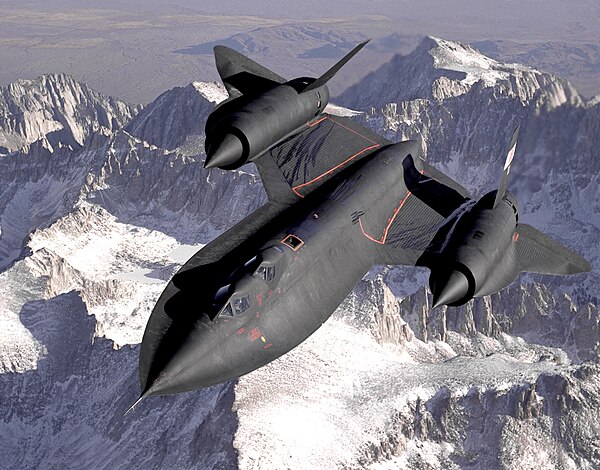
The SR-71 designation is a continuation of the pre-1962 bomber series; the last aircraft built using the series was the XB-70 Valkyrie. However, a bomber variant of the Blackbird was briefly given the B-71 designator, which was retained when the type was changed to SR-71.[18] During the later stages of its testing, the B-70 was proposed for a reconnaissance/strike role, with an "RS-70" designation. When the A-12's performance potential was clearly found to be much greater, the USAF ordered a variant of the A-12 in December 1962,[19] which was originally named R-12 by Lockheed.[N 2] This USAF version was longer and heavier than the original A-12 because it had a longer fuselage to hold more fuel. The R-12 also had a larger two-seat cockpit, and reshaped fuselage chines. Reconnaissance equipment included signals intelligence sensors, a side-looking airborne radar, and a photo camera.[19] The CIA's A-12 was a better photo-reconnaissance platform than the USAF's R-12, since the A-12 flew somewhat higher and faster, and with only one pilot, it had room to carry a superior camera[16] and more instruments.[20] The A-12 flew covert missions while the SR-71 flew overt missions; the latter had USAF markings and pilots carried Geneva Conventions Identification Cards.[21] During the 1964 campaign, Republican presidential nominee Barry Goldwater repeatedly criticized President Lyndon B. Johnson and his administration for falling behind the Soviet Union in developing new weapons. Johnson decided to counter this criticism by revealing the existence of the YF-12A USAF interceptor, which also served as cover for the still-secret A-12[22] and the USAF reconnaissance model since July 1964. USAF Chief of Staff General Curtis LeMay preferred the SR (Strategic Reconnaissance) designation and wanted the RS-71 to be named SR-71. Before the July speech, LeMay lobbied to modify Johnson's speech to read "SR-71" instead of "RS-71". The media transcript given to the press at the time still had the earlier RS-71 designation in places, creating the story that the president had misread the aircraft's designation.[23][N 3] To conceal the A-12's existence, Johnson referred only to the A-11, while revealing the existence of a high speed, high altitude reconnaissance aircraft.[24] In 1968, Secretary of Defense Robert McNamara canceled the F-12 interceptor program. The specialized tooling used to manufacture both the YF-12 and the SR-71 was also ordered destroyed.[25] Production of the SR-71 totaled 32 aircraft with 29 SR-71As, two SR-71Bs, and the single SR-71C.[26]